




What is the effect of pipe length on the performance of radiant manifolds?
 Jan 01, 2026|
 As a supplier of radiant manifolds, I've witnessed firsthand the critical role that various design factors play in determining the overall performance of these systems. One such factor that often goes under the microscope is the pipe length in radiant manifolds. In this blog post, I'll explore the effects of pipe length on the performance of radiant manifolds, drawing on both theoretical knowledge and practical experience.
Hydraulic Resistance
One of the most immediate impacts of pipe length on radiant manifolds is its effect on hydraulic resistance. Hydraulic resistance refers to the opposition to fluid flow in a piping system, and it is directly proportional to the length of the pipe. As the pipe length increases, the fluid has to travel a greater distance, encountering more friction along the way. This frictional force acts to impede the flow of the fluid, increasing the pressure drop across the system.
In a radiant manifold system, a higher pressure drop means that the pump has to work harder to maintain the desired flow rate. This not only increases energy consumption but can also lead to premature wear and tear on the pump. Moreover, uneven pressure distribution within the manifold can result in inconsistent flow rates through the individual circuits, causing some areas to receive less heat while others are over - heated.
To mitigate these issues, careful consideration should be given to the pipe sizing and the layout of the radiant manifold system. Larger diameter pipes generally have lower hydraulic resistance, so they can be used in longer runs to reduce the pressure drop. Additionally, proper zoning and balancing of the system can help ensure that each circuit receives an adequate and uniform flow of fluid.
Heat Transfer
Pipe length also has a significant impact on heat transfer in radiant manifold systems. The primary function of a radiant manifold is to distribute hot water (or another heat - transfer fluid) to various zones in a building to provide heating. During the fluid's journey through the pipes, heat is transferred from the fluid to the surrounding environment, such as the floor in an underfloor heating system.
A longer pipe length means that the fluid has more surface area in contact with the surroundings, which can enhance the overall heat transfer. However, this also means that the fluid will lose more heat as it travels along the pipe. As a result, the temperature of the fluid at the end of a long pipe run will be lower than at the beginning. This temperature drop can lead to uneven heating in the space, with areas closer to the manifold receiving more heat than those farther away.
In an ideal situation, the heat transfer should be optimized to ensure that each zone receives the appropriate amount of heat. This can be achieved by carefully calculating the pipe length, insulation, and flow rate. Insulating the pipes can significantly reduce heat loss during the fluid's transit, maintaining a more consistent temperature throughout the system. Additionally, using a variable - speed pump to adjust the flow rate based on the specific requirements of each zone can help compensate for the temperature drop along the pipe.
Thermal Response Time
The thermal response time of a radiant manifold system is another aspect affected by pipe length. Thermal response time refers to the time it takes for the system to reach a desired temperature after a change in the control settings. A longer pipe length means that there is more fluid volume in the system, which takes longer to heat up or cool down.
In a building where quick temperature adjustments are required, such as an office space that is occupied only during certain hours, a long pipe length can lead to a sluggish thermal response. For example, if the heating needs to be turned on in the morning, a system with long pipes may take a significant amount of time to reach the comfortable temperature, causing discomfort to the occupants.
To improve the thermal response time, shorter pipe lengths can be used, especially in areas where rapid temperature changes are necessary. Another solution is to divide the system into smaller zones, each with its own relatively short pipe runs. This allows for more precise control of the temperature in each zone and faster response times.
Impact on Product Selection
Considering the effects of pipe length on radiant manifold performance, it is crucial to carefully select the right products for the job. As a radiant manifolds supplier, I offer a range of products that can be tailored to different pipe length requirements. For instance, the Brass Flow - meter Manifolds are designed to provide accurate flow control and monitoring, which is essential for maintaining proper hydraulic balance in systems with varying pipe lengths.
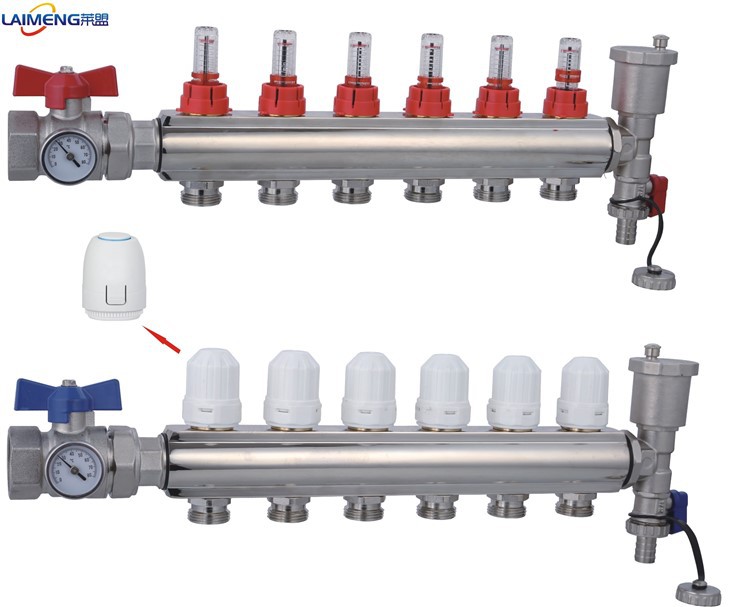

The Under Floor Heating Forged Brass Radiant Water Manifold Floor Heating System is another excellent option for underfloor heating applications. The forged brass construction ensures durability, and the design can be optimized for different pipe lengths to achieve efficient heat transfer.
For those specifically looking for parts with a flow meter for floor heating systems, our Brass Collectors Brass Water Manifold With Flow Meter For Floor Heating Systems Parts offer precision control over the fluid flow, which can be particularly beneficial in systems with long pipe runs to ensure uniform heating.
Conclusion
In conclusion, the pipe length in radiant manifolds has a profound effect on various aspects of system performance, including hydraulic resistance, heat transfer, and thermal response time. As a supplier of radiant manifolds, I understand the importance of balancing these factors to provide our customers with an efficient and reliable heating solution. Whether you are installing a new radiant manifold system or upgrading an existing one, careful consideration of pipe length and product selection is essential.
If you are interested in learning more about our radiant manifold products or need assistance in selecting the right components for your project, please feel free to contact us. Our team of experts is ready to help you design and implement a high - performance radiant heating system that meets your specific requirements.
References
- Karayiannis, T. G., & Jaluria, Y. (Eds.). (2004). Handbook of Single - Phase Convective Heat Transfer. Wiley.
- Incropera, F. P., & DeWitt, D. P. (2002). Fundamentals of Heat and Mass Transfer. Wiley.
- ASHRAE Handbook—HVAC Systems and Equipment. (2019). American Society of Heating, Refrigerating and Air - Conditioning Engineers.